The Challenge
An automotive powertrain engineering firm engaged our services to manufacture a critical batch of heavy-duty coupling fixtures used in high-torque dyno testing rigs. The component required machining from solid bar stock of Inconel 718 ($NiCr19FeNbMo$), a nickel-based superalloy chosen for its exceptional tensile strength and fatigue life under extreme thermal loads. However, Inconel 718 presents extreme manufacturing challenges due to its low thermal conductivity, high abrasiveness, and tendency to rapidly work-harden, which typically leads to catastrophic cutting-tool failure and severe dimensional drift.
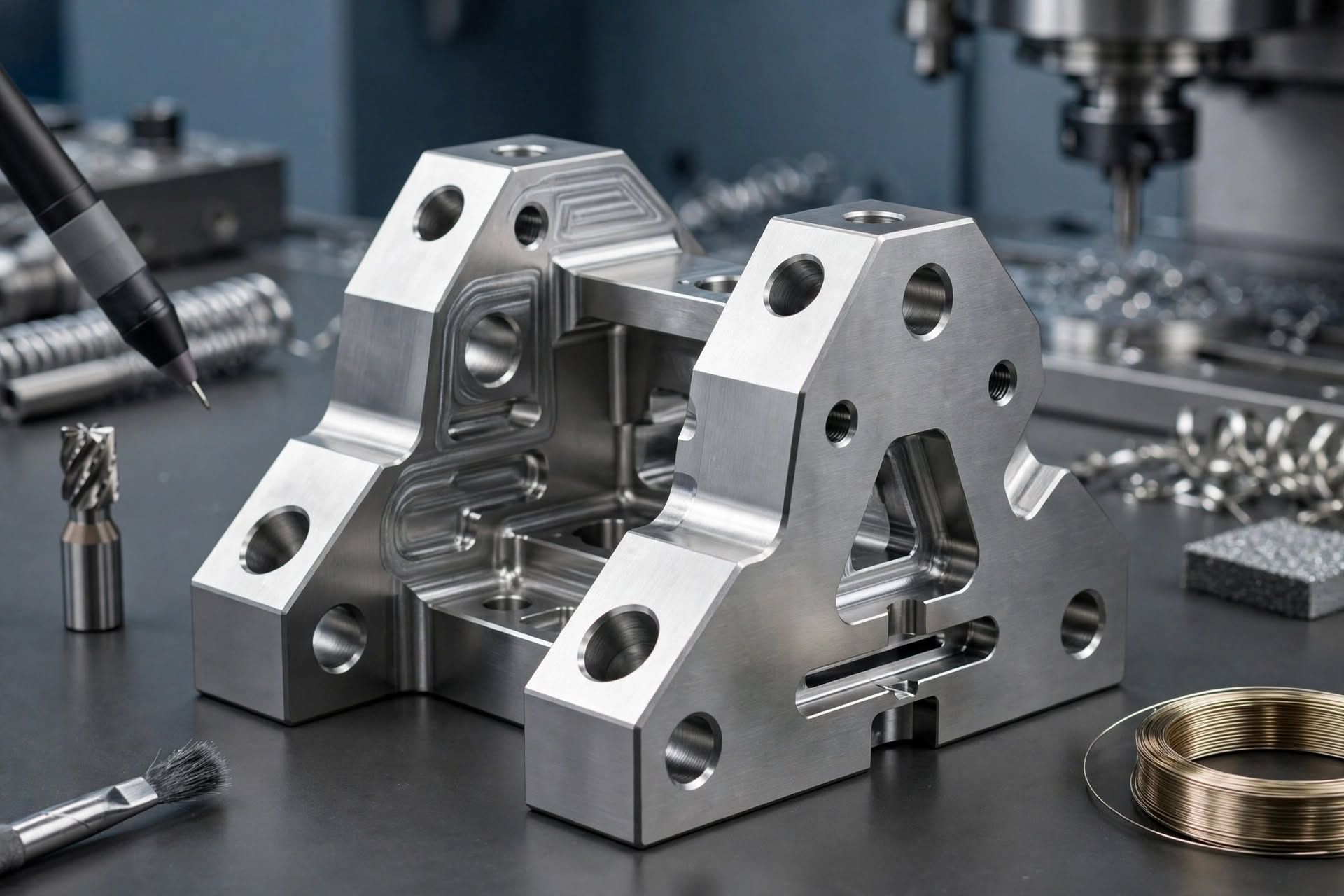
The component’s geometry featured a dense, multi-flanged coupling head with intricate weight-reduction pockets, thin-walled webs ($1.2\text{ mm}$ thick), and high-precision splined bores. The engineering drawings dictated a tight true position tolerance of $\pm0.01\text{ mm}$ relative to the central datum axis and a maximum surface roughness profile of $0.4\text{ }\mu\text{m Ra}$ across the load-bearing faces. The client’s previous subcontract machinist struggled with excessive tool deflection and severe surface tearing, resulting in a rejection rate exceeding 30% and an unstable four-week production lead time.
The Engineered Solution
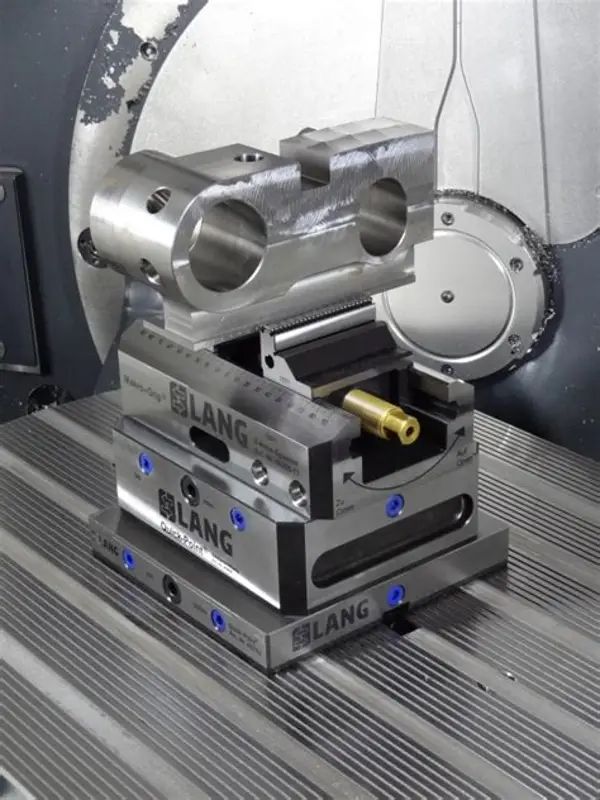
Our processing engineers designed a rigid, single-source manufacturing layout that utilized the advanced capabilities of our facility, setting a high standard for subcontract manufacturing UK wide. We initiated the process in our heavy-duty turning cells. To manage the massive cutting forces generated by Inconel 718, we utilized bespoke ceramic turning inserts for the heavy roughing stages, allowing us to run at higher cutting speeds ($v_c = 200\text{ m/min}$) to intentionally plasticize the material directly ahead of the tool edge, which prevented rapid flank wear.
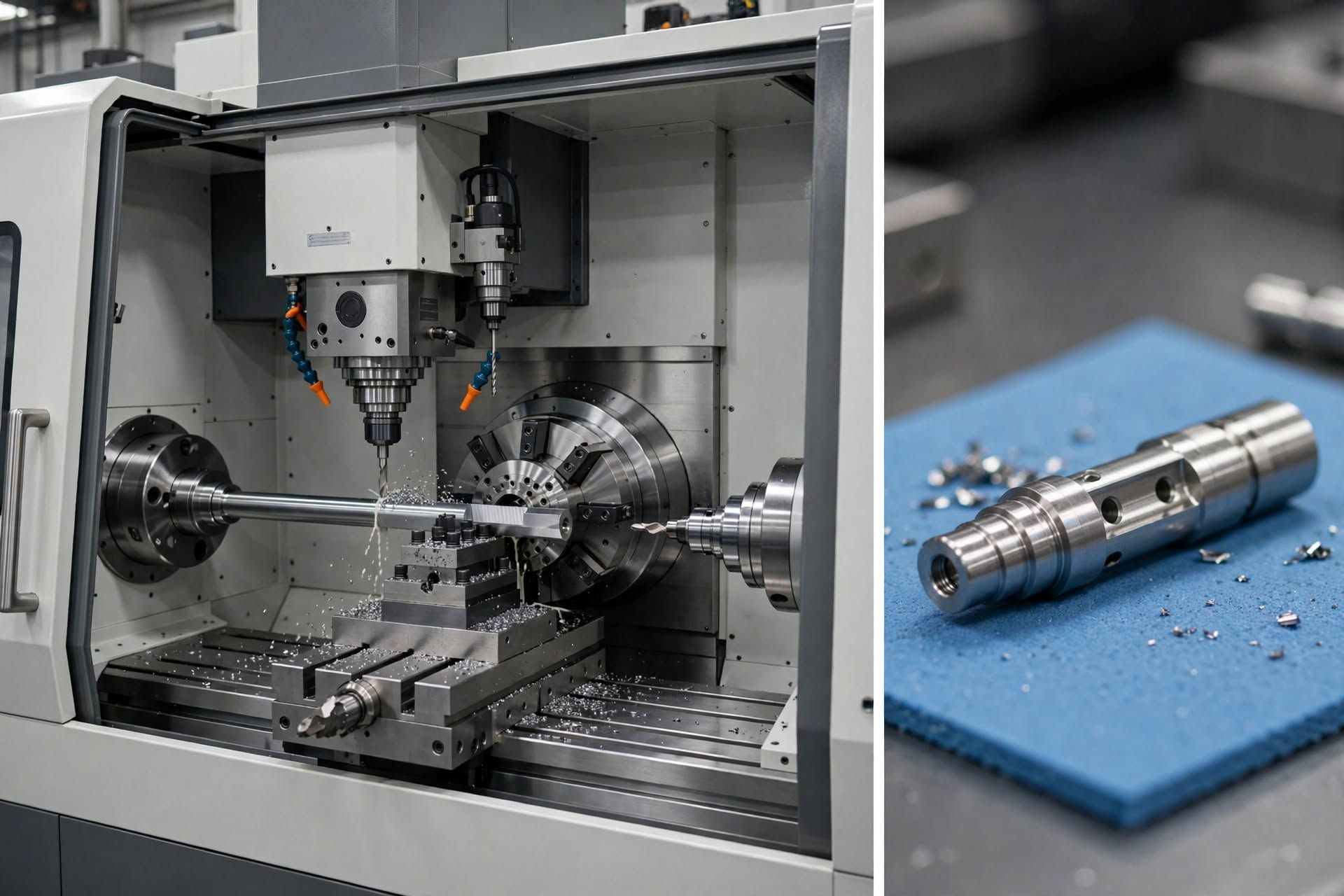
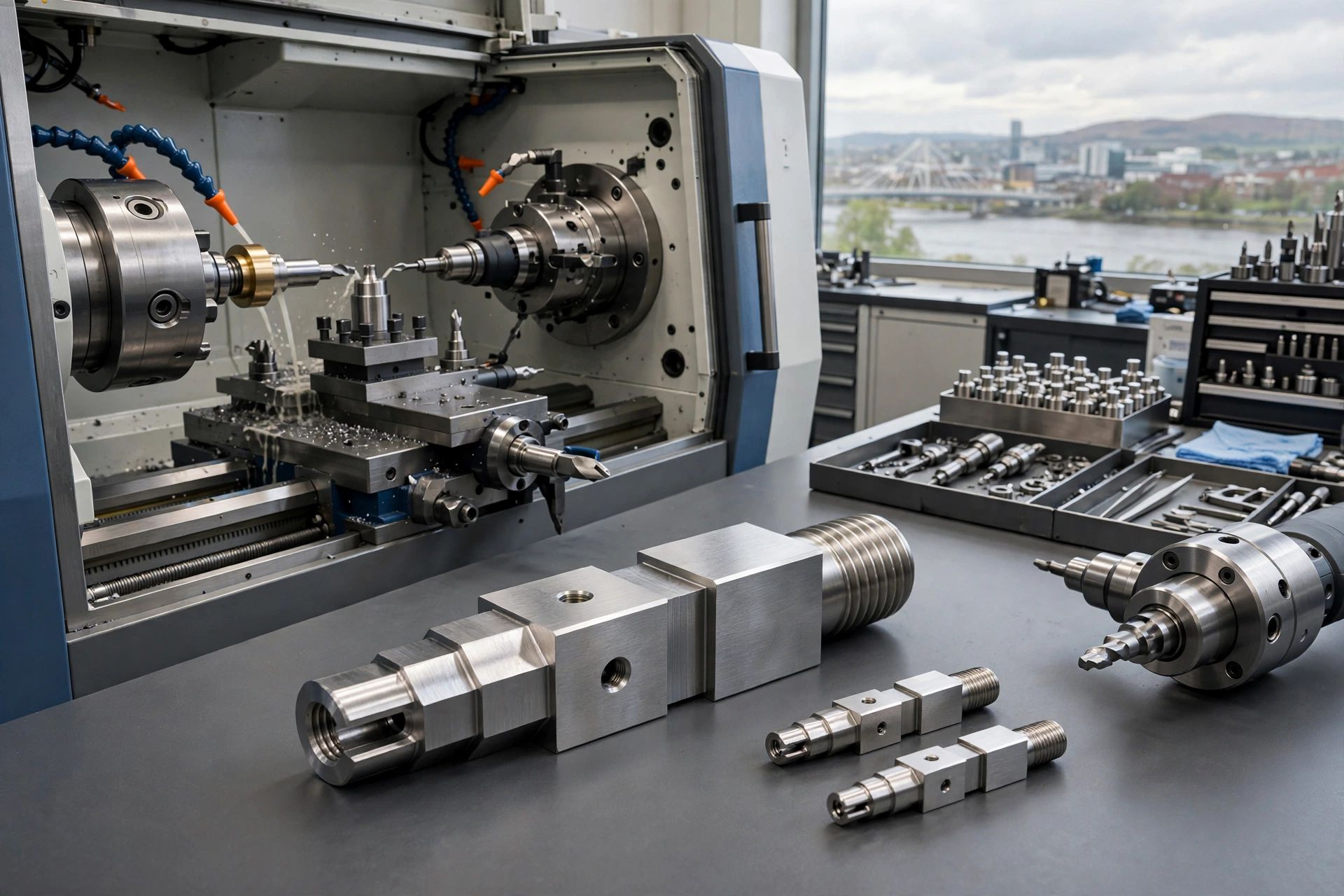
For the intricate internal splines and accompanying fastening studs required for the final sub-assembly engineering package, we routed the small-diameter sub-components to our CNC sliding head turning department. Operating high-rigidity CNC sliding head turning lathes allowed us to feed the tough stock material through a specialized guide bushing directly adjacent to the cutting tools. This setup completely eliminated the risk of part deflection, allowing us to hold linear dimensions within $\pm0.005\text{ mm}$ on a high-volume run.
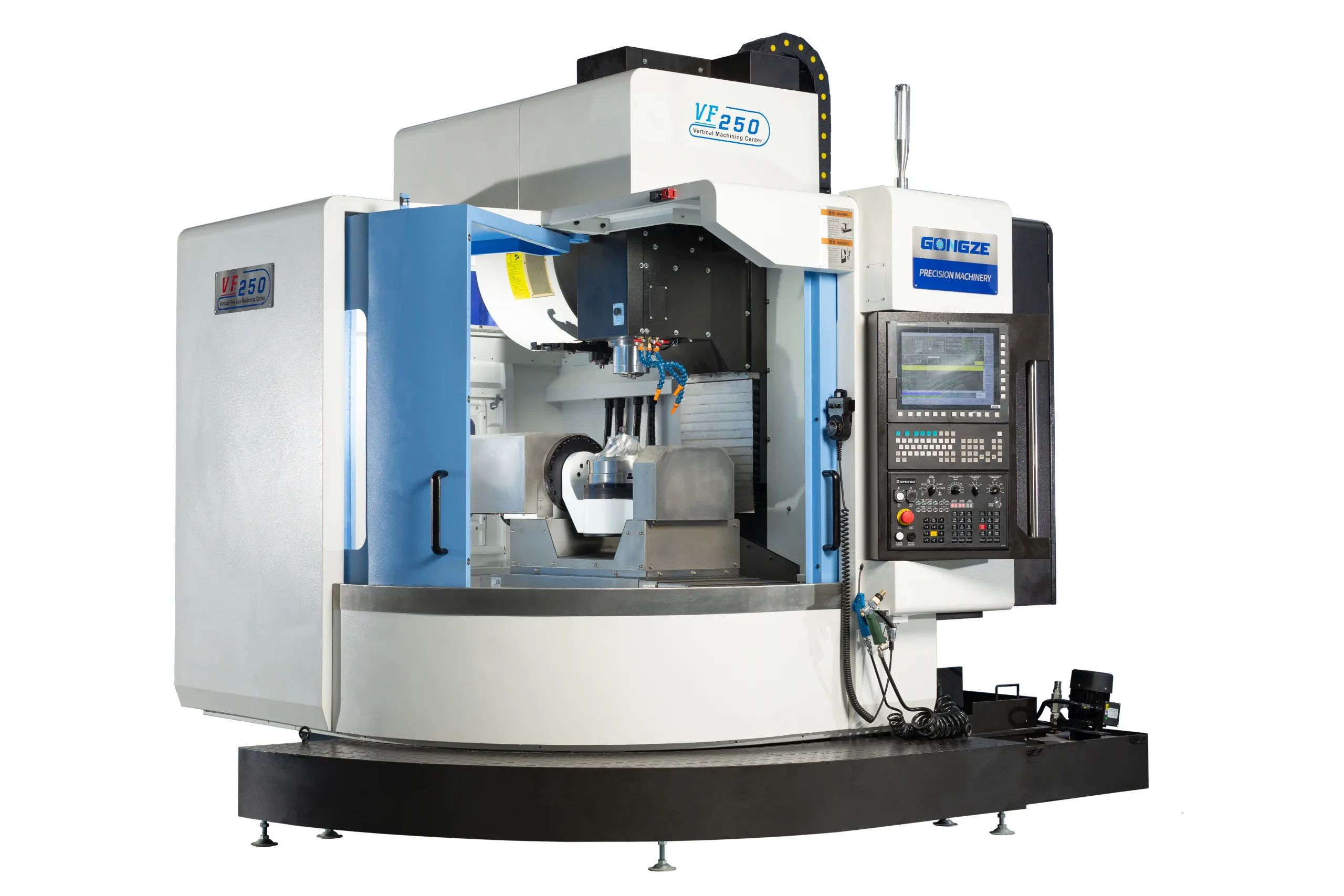
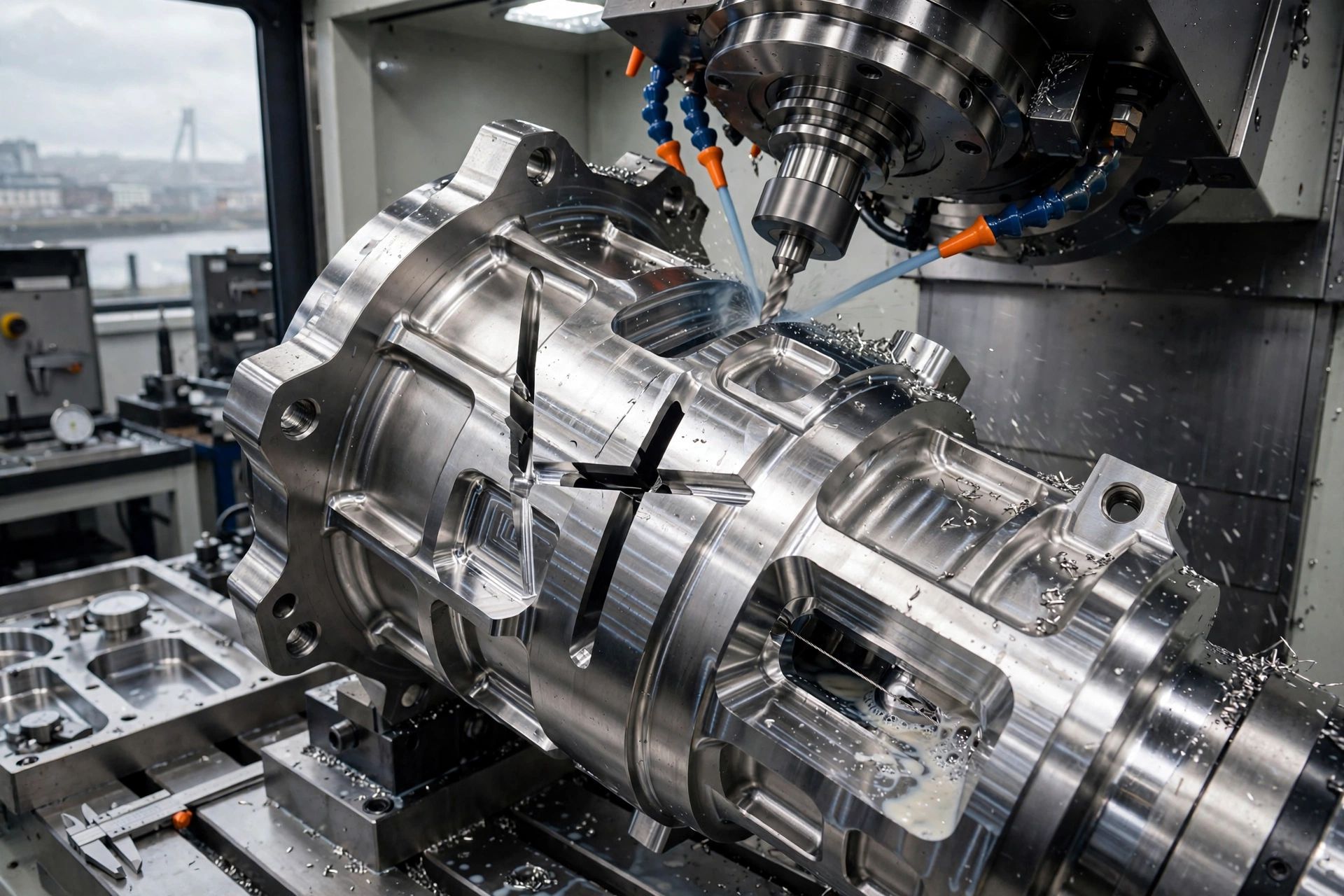
The primary coupling fixture was then indexed directly into our continuous 5-axis CNC milling center. By employing full 5-axis simultaneous motion, we accessed all off-axis weight-reduction pockets and thin-walled webs in a single clamping setup. To eliminate tool chatter and structural vibration in the delicate $1.2\text{ mm}$ walls, we deployed dynamic, trochoidal roughing strategies. We programmed low radial immersion ($a_e = 5\%$) paired with full axial depth of cut ($a_p = 100\%$) using custom-ground solid carbide endmills coated with an advanced TiAlN matrix. This precise toolpath balance effectively directed cutting heat into the exiting chips rather than the workpiece, preserving the structural integrity of the metal.
Finally, any specialized internal splines or sharp corners where conventional milling tools lacked clearing access were routed through our high-precision EDM wire erosion Scotland workshop. This process vaporized the superalloy with microscopic accuracy, protecting the critical splined boundaries from residual stress.
The Outcome & Operational Impact
By combining specialized tool geometries with multi-axis CNC machines under one roof, Strategic Innovations Dundee Ltd provided a Masterclass in CNC machining Scotland capabilities.
- Cycle Time Optimization: The shift to single-setup 5-axis milling and optimized toolpaths yielded a 45% reduction in individual cycle times.
- Zero Scrap Rates: Tool deflection was entirely mitigated, dropping the client’s historical 30% rejection rate down to a flawless 0% scrap run.
- Surface Superiority: The load-bearing flange faces achieved a polished surface finish of 0.28 $\mu$m Ra, easily surpassing the minimum $0.4\text{ }\mu\text{m}$ benchmark.
- Lead Time Compressed: Total delivery schedules for the completed assemblies dropped from 28 calendar days down to just 10 working days.
This industrial achievement solidifies our market footing as an authority in precision engineering Dundee can depend on for complex, high-stress components across the automotive, energy, and defense sectors.
Have a complex engineering component or production bottleneck? Send your technical specifications and RFQ straight to the engineering team at Strategic Innovations Dundee Ltd for a comprehensive manufacturing evaluation.